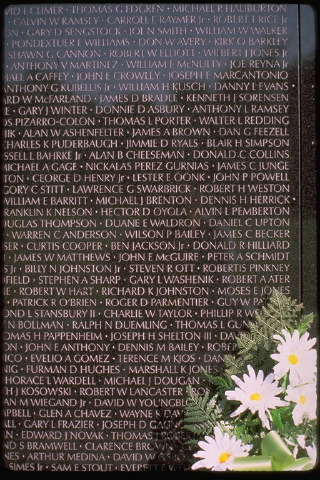
Vietnam Veterans Memorial
Vietnam Veterans Memorial
The United States dominated global affairs in the years immediately after World War II. Victorious in that great struggle, its homeland undamaged from the ravages of war, the nation was confident of its mission at home and abroad. U.S. leaders wanted to maintain the democratic structure they had defended at tremendous cost and to share the benefits of prosperity as widely as possible. For them, as for publisher Henry Luce of Time magazine, this was the "American Century."For 20 years most Americans remained sure of this confident approach. They accepted the need for a strong stance against the Soviet Union in the Cold War that unfolded after 1945. They endorsed the growth of government authority and accepted the outlines of the rudimentary welfare state first formulated during the New Deal. They enjoyed a postwar prosperity that created new levels of affluence.
But gradually some began to question dominant assumptions. Challenges on a variety of fronts shattered the consensus. In the 1950s, African Americans launched a crusade, joined later by other minority groups and women, for a larger share of the American dream. In the 1960s, politically active students protested the nation's role abroad, particularly in the corrosive war in Vietnam.
Indochina (Vietnam, Laos, Cambodia), a French possession before World War II, was still another Cold War battlefield. The French effort to reassert colonial control there was opposed by Ho Chi Minh, a Vietnamese Communist, whose Viet Minh movement engaged in a guerrilla war with the French army.
Both Truman and Eisenhower, eager to maintain French support for the policy of containment in Europe, provided France with economic aid that freed resources for the struggle in Vietnam. But the French suffered a decisive defeat in Dien Bien Phu in May 1954. At an international conference in Geneva, Laos and Cambodia were given their independence. Vietnam was divided, with Ho in power in the North and Ngo Dinh Diem, a Roman Catholic anti-Communist in a largely Buddhist population, heading the government in the South. Elections were to be held two years later to unify the country. Persuaded that the fall of Vietnam could lead to the fall of Burma, Thailand, and Indonesia, Eisenhower backed Diem's refusal to hold elections in 1956 and effectively established South Vietnam as an American client state.
Kennedy increased assistance, and sent small numbers of military advisors, but a new guerrilla struggle between North and South continued. Diem's unpopularity grew and the military situation worsened. In late 1963, Kennedy secretly assented to a coup d'etat. To the president's surprise, Diem and his powerful brother-in-law, Ngo Dien Nu, were killed. It was at this uncertain juncture that Kennedy's presidency ended three weeks later.
Determined to halt Communist advances in South Vietnam, Johnson made the Vietnam War his own. After a North Vietnamese naval attack on two American destroyers, Johnson won from Congress on August 7, 1964, passage of the Gulf of Tonkin Resolution, which allowed the president to "take all necessary measures to repel any armed attack against the forces of the United States and to prevent further aggression." After his re-election in November 1964, he embarked on a policy of escalation. From 25,000 troops at the start of 1965, the number of soldiers -- both volunteers and draftees -- rose to 500,000 by 1968. A bombing campaign wrought havoc in both North and South Vietnam.
Grisly television coverage with a critical edge dampened support for the war. Some Americans thought it immoral; others watched in dismay as the massive military campaign seemed to be ineffective. Large protests, especially among the young, and a mounting general public dissatisfaction pressured Johnson to begin negotiating for peace.
By 1968 the country was in turmoil over both the Vietnam War and civil disorder, expressed in urban riots that reflected African-American anger. On March 31, 1968, the president renounced any intention of seeking another term. Just a week later, Martin Luther King Jr. was shot and killed in Memphis, Tennessee. John Kennedy's younger brother, Robert, made an emotional anti-war campaign for the Democratic nomination, only to be assassinated in June.
Determined to achieve "peace with honor," Nixon slowly withdrew American troops while redoubling efforts to equip the South Vietnamese army to carry on the fight. He also ordered strong American offensive actions. The most important of these was an invasion of Cambodia in 1970 to cut off North Vietnamese supply lines to South Vietnam. This led to another round of protests and demonstrations. Students in many universities took to the streets. At Kent State in Ohio, the national guard troops who had been called in to restore order panicked and killed four students.
By the fall of 1972, however, troop strength in Vietnam was below 50,000 and the military draft, which had caused so much campus discontent, was all but dead. A cease-fire, negotiated for the United States by Nixon's national security adviser, Henry Kissinger, was signed in 1973. Although American troops departed, the war lingered on into the spring of 1975, when Congress cut off assistance to South Vietnam and North Vietnam consolidated its control over the entire country.
The war left Vietnam devastated, with millions maimed or killed. It also left the United States traumatized. The nation had spent over $150,000-million in a losing effort that cost more than 58,000 American lives. Americans were no longer united by a widely held Cold War consensus, and became wary of further foreign entanglements.
Alabama
Alaska
Arizona
Arkansas
California
Colorado
Connecticut
Delaware
Florida
Georgia
Hawaii
Idaho
Illinois
Indiana
Iowa
Kansas
Kentucky
Louisiana
Maine
Maryland
Massachusetts
Michigan
Minnesota
Mississippi
Missouri
Montana
Nebraska
Nevada
New
Hampshire
New
Jersey
New
Mexico
New York
North
Carolina
North
Dakota
Ohio
Oklahoma
Oregon
Pennsylvania
Rhode
Island
South
Carolina
South
Dakota
Tennessee
Texas
Utah
Vermont
Virginia
Washington
West
Virginia
Wisconsin
Wyoming
Washington
D.C.
Home