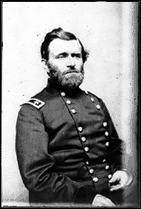
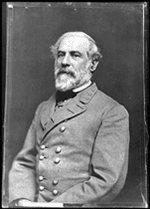
Grant (L) - Lee (R)
Surrender at Appomattox Courthouse
Surrender at Appomattox Courthouse
On April 9, 1865 after four years of Civil War, approximately 630,000 deaths and over 1 million casualties, General Robert E. Lee surrendered the Confederate Army of Northern Virginia to Lieutenant General Ulysses S. Grant, at the home of Wilmer and Virginia McLean in the rural town of Appomattox Court House, Virginia.
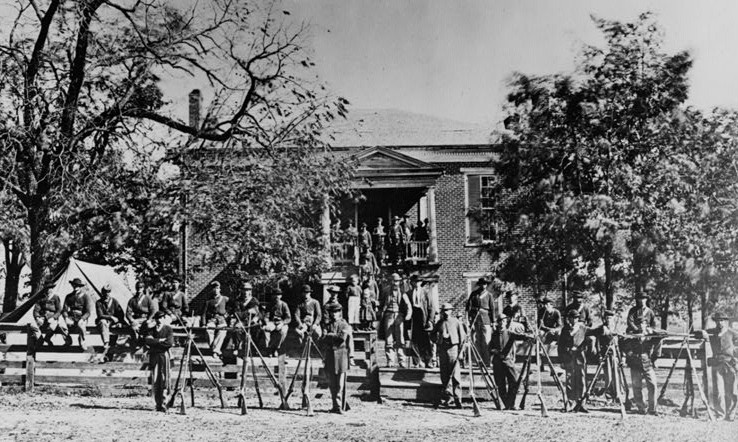
On April 10, 1865 Generals Lee and Grant met for a 2nd time at Appomattox Court House, Virginia. In the 2nd meeting General Lee requested that his men be given evidence that they were paroled prisoners - to protect them from arrest or annoyance. 28,231 Parole passes were issued to the Confederates.When Lee surrendered his army at Appomattox, thirty-six African-Americans were listed on the Confederate paroles. Most were either servants, free blacks, musicians, cooks, teamsters or blacksmiths. A Black woman was to become the only civilian casualty in the final fighting at Appomattox. Hannah stayed behind with her husband in the home of Doctor Coleman located on the battlefield and was mortally wounded by an artillery round. A Union chaplain remembered: "she was sick with fever and unable to be moved. As she lay upon her bed, a solid shot had passed through one wall of the house at just the right height to strike her arm, and then passed out through the opposite wall." Few black Southerners served as combat troops in the Confederate Army, many served in other capacities.
The end of the war led directly to the adoption of the 13th, 14th, and 15th amendments to the Constitution – ending slavery, providing citizenship and male suffrage.
Alabama
Alaska
Arizona
Arkansas
California
Colorado
Connecticut
Delaware
Florida
Georgia
Hawaii
Idaho
Illinois
Indiana
Iowa
Kansas
Kentucky
Louisiana
Maine
Maryland
Massachusetts
Michigan
Minnesota
Mississippi
Missouri
Montana
Nebraska
Nevada
New
Hampshire
New
Jersey
New
Mexico
New York
North
Carolina
North
Dakota
Ohio
Oklahoma
Oregon
Pennsylvania
Rhode
Island
South
Carolina
South
Dakota
Tennessee
Texas
Utah
Vermont
Virginia
Washington
West
Virginia
Wisconsin
Wyoming
Washington
D.C.
Home