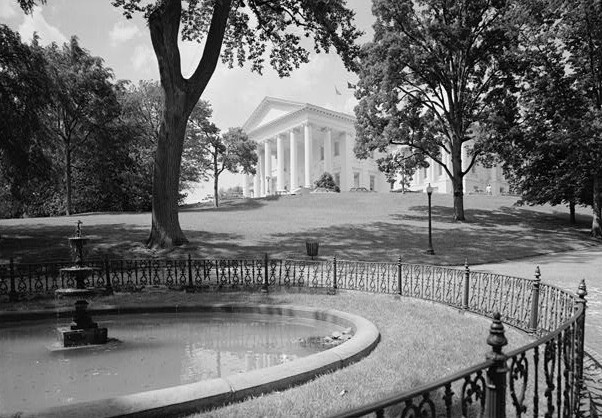
Virginia State
Capitol
Richmond, Virginia
The Virginia State Capitol, conceived in 1785, is the second oldest working capitol in the United States. Designed by Thomas Jefferson while he was in France, the building was modelled after a Roman temple, the Maison Carree. While Jefferson did not directly copy the Maison Carree, but modified it to accommodate modern necessities, he did respect the general temple form and introduced the Classical Revival style into America. A half a century after the erection of the building, the General Assembly commissioned Maximilian Godefroy to develop a landscaping plan that would supply an appropriate setting for the public building. The formal French layout that resulted was drastically transformed in 1850 by John Notman who turned Capitol Square into the first picturesque park in America.
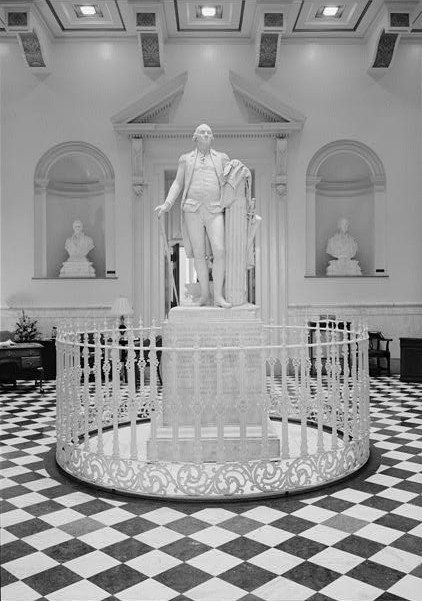
The Capitol building remained intact until the Capitol disaster of 1870 in which a structural failure caused the destruction of the north end of the building. Following the catastrophe, the building was restored only to be completely gutted, renovated and enlarged with the addition of 1902-04. This addition, designed collaboratively by the architecture firms of Noland and Baskervill, Frye and Chesterman, and Peebles, consisted of the addition of front stairs and two wings with connecting hyphens, to house the Senate chamber and the hall of the House of Delegates.

Alabama
Alaska
Arizona
Arkansas
California
Colorado
Connecticut
Delaware
Florida
Georgia
Hawaii
Idaho
Illinois
Indiana
Iowa
Kansas
Kentucky
Louisiana
Maine
Maryland
Massachusetts
Michigan
Minnesota
Mississippi
Missouri
Montana
Nebraska
Nevada
New
Hampshire
New
Jersey
New
Mexico
New
York
North
Carolina
North
Dakota
Ohio
Oklahoma
Oregon
Pennsylvania
Rhode
Island
South
Carolina
South
Dakota
Tennessee
Texas
Utah
Vermont
Virginia
Washington
West
Virginia
Wisconsin
Wyoming
Washington
D.C.
Home